


Author :- Ms. Shraddha Dixit
What the Evidence Actually Supports
Variation gets marketed as ‘muscle confusion’ more often than it gets explained as a physiological tool. It is
the latter, and the research on how to structure it is more settled and less exciting than most coaching content
suggests.
Why vary the stimulus at all
For a training program to remain effective it must continually overload the neuromuscular system; a stimulus the system has already fully adapted to stops producing further adaptation (Kraemer & Ratamess, 2004). Structured variation is proposed to force the neuromuscular system to keep responding to an unaccustomed stress, while prolonged, unvaried loading is associated with fatigue accumulation and stagnation without corresponding gains (Kraemer et al., 1988; Williams et al, 2018).

Linear vs. undulating periodization
Linear periodization (LP) begins with higher volume and lower intensity and progresses toward lower volume
and higher intensity across meso- and macrocycles, typically shifting phases roughly every four weeks (Rhea
et al., 2002). Undulating periodization (UP) manipulates volume and intensity far more frequently daily
(DUP) or weekly (WUP) rather than across multi-week blocks (Poliquin, 1988).
Here is where a lot of coaching content overstates the evidence: multiple systematic reviews and meta
analyses directly comparing LP and UP consistently find no significant difference in strength or hypertrophy
outcomes between the two models when total volume and intensity are equated (Harries, Lubans & Callister
systematic review; PMC5571788 hypertrophy-specific meta-analysis; 2026 Frontiers systematic
review/meta-analysis). There is some indication UP may hold a theoretical edge in early training stages while
LP performs comparably or better later in a training career, but the mechanistic explanation remains limited
and effect sizes are small. Neither model is the scientifically ‘correct’ one that framing doesn’t survive the
pooled data.
Block periodization: the model often left out of the comparison
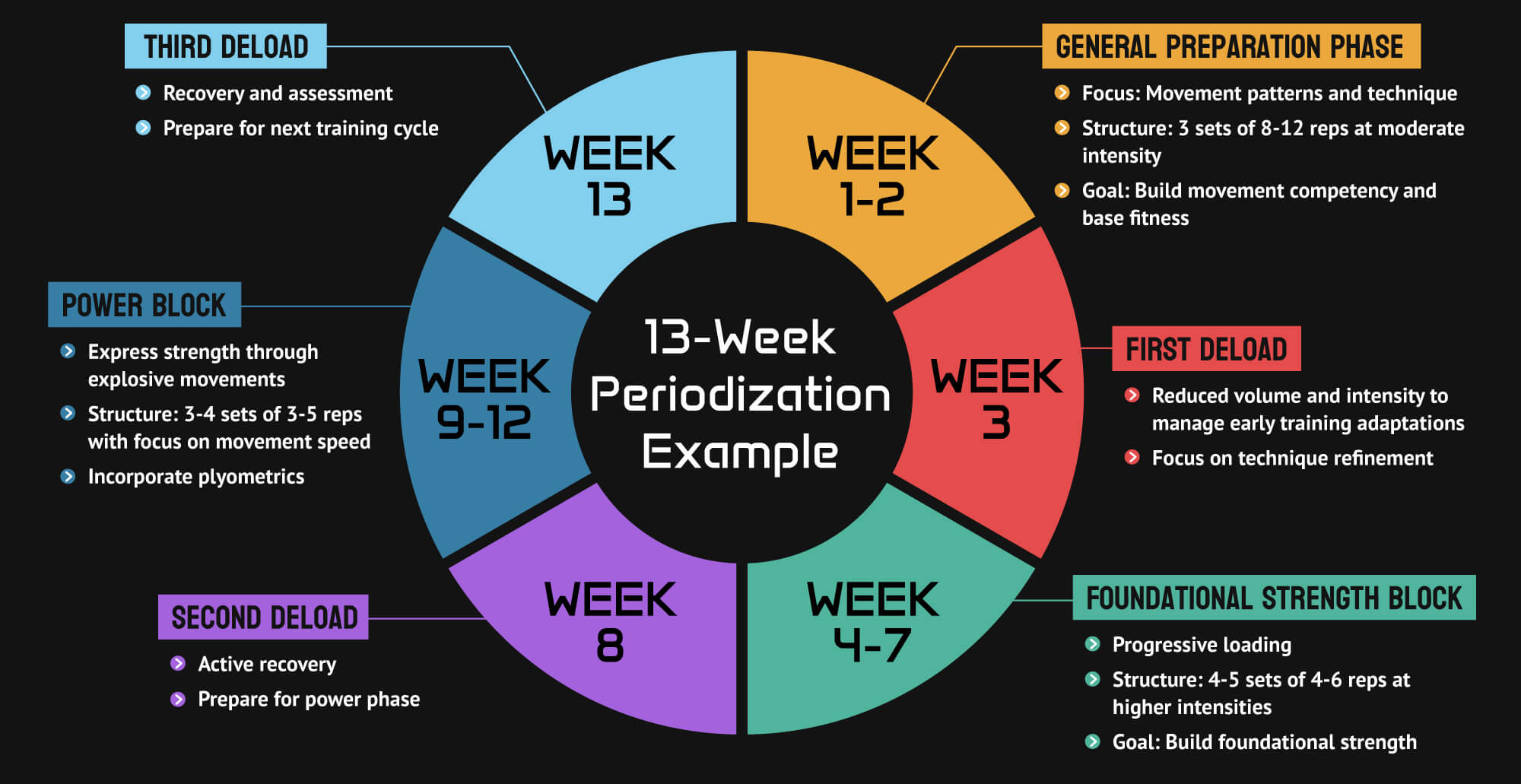
Block periodization concentrates training stress on a small number of abilities per block sequentially for example, strength-endurance, then maximal strength, then power rather than spreading conflicting adaptations across every week simultaneously. It tends to suit higher-training-age athletes who need to resolve competing physiological demands (e.g, aerobic base development versus maximal strength) that don’t program well in parallel.

Variation below the macrocycle level
Periodization model choice is macrostructure. Variation also operates at the microstructure level: exercise
selection (barbell versus unilateral versus machine variants of the same movement pattern), tempo
manipulation (eccentric emphasis), rep-range blocks, and set structure straight sets, cluster sets, drop sets,
and supersets. Autoregulation using RPE or reps-in-reserve is a further variation lever, adjusting daily load
to actual readiness rather than a pre-written number, and can be layered on top of any of the periodization
models above rather than treated as a separate competing system. This is where untrained variation gets
misapplied as marketing rather than used as a targeted lever tied to a specific adaptation goal.
Practical application: choosing a model without the hype
Use training age as your first filter: novice and early-intermediate lifters generally tolerate and progress on
either LP or UP, since almost any structured overload works for them the model matters far less than
consistency. For advanced or elite athletes managing a long competitive season, block periodization becomes
more relevant because it resolves the interference problem between conflicting adaptations (e.g., maximal
strength and high-volume conditioning) that daily or weekly undulation handles poorly at high training ages.
Match model choice to the competition calendar: LP suits a single clear peak (one major competition), UP
suits athletes needing to maintain multiple qualities simultaneously across a longer season, and block
periodization suits athletes with distinct, sequential preparation phases.
- Novice/early-intermediate: model choice matters less than consistent progressive overload either LP or UP will work.
- Advanced/elite with a single peak: linear periodization aligns cleanly with a defined taper toward one competition.
- Advanced/elite with competing seasonal demands: block periodization resolves the interference between conflicting adaptations better than either LP or UP alone.

Common mistakes practitioners make with periodization
The most common mistake is picking a periodization model as an identity statement rather than a tool coaches
attach themselves to ‘I run undulating’ or ‘I run conjugate’ as a philosophy, then force every athlete and every
phase into that model regardless of fit. The meta-analytic evidence doesn’t support treating any single model
as universally superior, so a rigid allegiance to one system is optimizing for the coach’s preference, not the
athlete’s outcome. A second mistake is confusing variation with randomness genuine periodization varies
load and volume according to a planned structure tied to a specific adaptation goal, while unplanned session
to-session variety driven by boredom or a desire to seem sophisticated produces neither the stability of a fixed
program nor the intended benefit of true periodized variation. A third mistake is under-crediting training age
as the dominant variable: the same periodization decision that barely matters for a novice (who will adapt to
almost any structured overload) can be the deciding factor for an advanced athlete chasing a much smaller
remaining margin of improvement treating both populations with the same programming logic wastes the
novice’s easy gains and under-serves the advanced athlete’s narrow window.
Bottom line: don’t choose linear or undulating periodization because one sounds more sophisticated the pooled meta-analytic evidence shows both work about equally well for strength and hypertrophy when volume and intensity are matched. Choose based on training age, competition calendar, and which specific adaptation needs the longest uninterrupted exposure right now.

References
- Comparison of linear and undulating periodization resistance training on athletic capacities and health promotion: A systematic review and meta-analysis. Frontiers in Public Health .
- Periodized resistance training for enhancing skeletal muscle hypertrophy and strength: A mini-review. Frontiers in Physiology
- Systematic review and meta-analysis of linear and undulating periodized resistance training programs on muscular strength. Harries, S. K., Lubans, D. R., & Callister, R. -Effects of linear and daily undulating periodized resistance training programs on measures of muscle hypertrophy: A systematic review and meta-analysis.
- Comparison of periodized and non-periodized resistance training on strength and hypertrophy: Systematic review.
