
Why Athletes Shouldn't Train the Same Way All Year
By Prashant Dubey
If your athletes lift the same weights, run the same conditioning, and train with the same volume in December as they do in April, you are guaranteeing one of two outcomes: they peak at the wrong time or they break down before the season ends. Elite performance is not about “training hard all year”; it’s about training differently across the year so that performance peaks for competition while fatigue is managed.
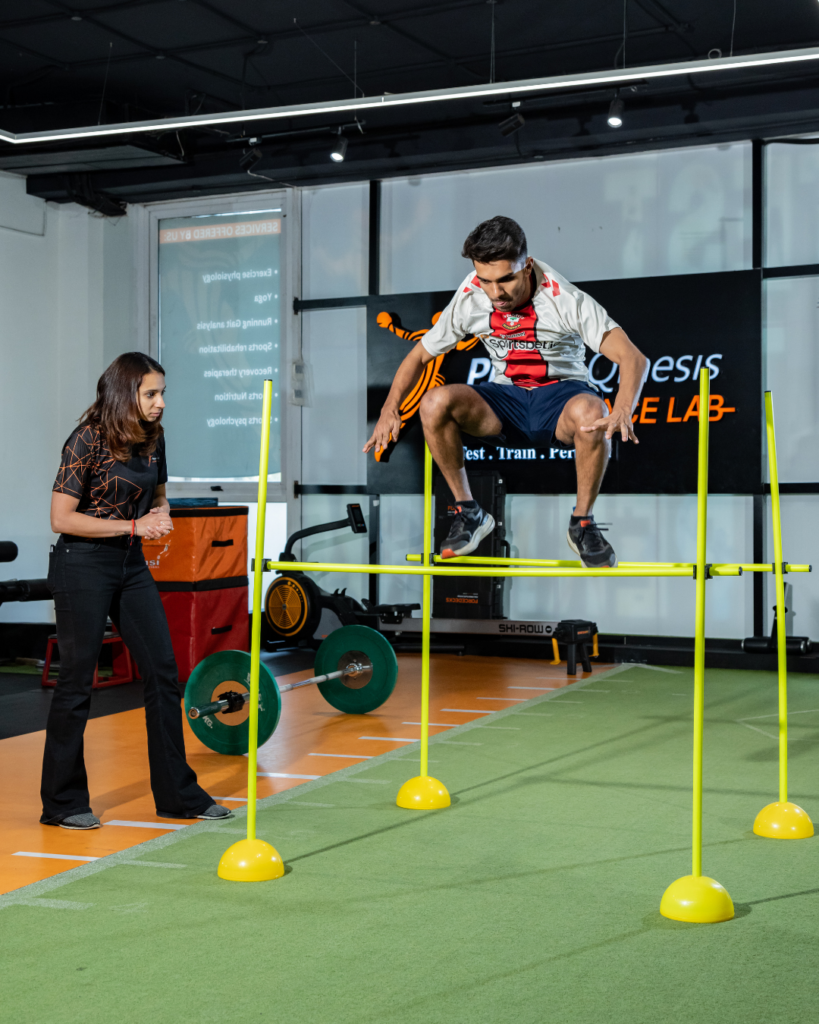
Adaptations: Off-Season vs In-Season
Off-Season Adaptations
The off-season is your primary development window. With reduced competition and practice loads, athletes can handle higher training volumes and a wider range of stimuli to build the physical qualities required for performance. Strength training using moderate loads (65–80% 1RM) and higher volumes (8–15 reps) promotes hypertrophy, particularly in the posterior chain, quads, glutes, and trunk, while progressive loading strengthens tendons and connective tissue and supports better force transmission.
Weight-bearing resistance training can also improve bone mineral density, which is particularly important in contact sports. Heavier lifting (80–90%+ 1RM) enhances motor unit recruitment and maximal strength, while power-based exercises such as jumps, throws, and Olympic-lift variations improve the rate of force development needed for sprinting, jumping, and change of direction.
From a metabolic perspective, Zone 2 training supports mitochondrial density and capillarization, improving recovery between high-intensity efforts, while higher training volumes develop greater work capacity and tolerance to repeated intense bouts. Ultimately, off-season training builds the engine—more muscle, stronger connective tissue, greater neural drive, improved power, and a stronger aerobic base. These adaptations require weeks to months of consistent, progressive training.
In-Season Adaptations
In-season, the goal shifts from building to maintaining. Competition and practice already impose significant physical and neural stress, so strength and conditioning should support performance without creating excessive fatigue. Strength can generally be maintained with around one-third to one-half of off-season training volume, provided intensity remains meaningful (≥80% 1RM or RPE 7–8), making quality exposure more important than high volume.
Short, high-quality sessions of jumps, sprints, and throws can help maintain power, speed, and rate of force development, while regular heavy loading helps preserve tendon stiffness and force transmission. Completely stopping strength training can lead to detraining within 2–4 weeks, with reductions in muscle size, neural drive, and tendon stiffness, potentially increasing vulnerability to soft-tissue issues.
The key takeaway is that in-season S&C should maintain the adaptations built during the off-season while managing fatigue, helping athletes stay strong, powerful, and physically prepared throughout the competitive season.
Takeaway: In-season S&C is insurance. You’re not trying to set personal records; you’re protecting the adaptations you built off-season and ensuring athletes stay robust through the competitive grind.
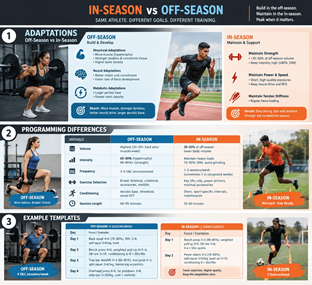
Programming Differences
Variable | Off-Season | In-Season |
Volume | Highest of the year (10–20+ hard sets/muscle/week) | 30–50% of off-season lower-body volume |
Intensity | Broad spectrum: hypertrophy 65–80%, strength 80–90%+ | Maintain heavy loads 75–90% 1RM, avoid grinding |
Frequency | 3–5 S&C sessions/week | 1–2 sessions/week (sometimes 1 in congested weeks) |
Exercise selection | Broad: bilateral, unilateral, accessories, mobility | Key lifts only, power primers, minimal accessories |
Conditioning | Aerobic base, threshold, some HIIT | Short, sport-specific intervals, maintenance |
Session length | 60–90 minutes | 35–60 minutes |
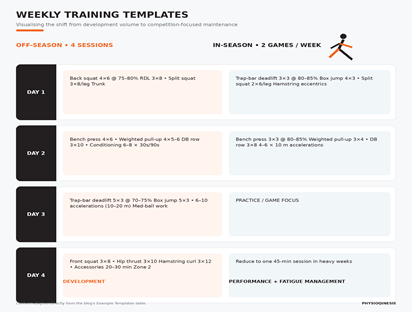
Example Templates
Day | Off-Season (4 sessions/week) | In-Season (2 games/week) |
Day 1 | Back squat 4×6 at 75–80%, RDL 3×8, split squat 3×8/leg, trunk | Trap bar deadlift 3×3 at 80–85%, box jump 4×3, split squat 2×6/leg, hamstring eccentrics |
Day 2 | Bench press 4×6, weighted pull-up 4×5–6, DB row 3×10, conditioning 6–8 × 30s/90s | Bench press 3×3 at 80–85%, weighted pull-up 3×4, DB row 3×8, 4–6 × 10m accelerations |
Day 3 | Trap bar deadlift 5×3 at 70–75%, box jump 5×3, 6–10 accelerations (10–20m), med ball | — (practice/game focus) |
Day 4 | Front squat 3×8, hip thrust 3×10, hamstring curl 3×12, accessories, 20–30 min Zone 2 | — (reduce to one 45-min session in heavy weeks) |
Recovery and Monitoring
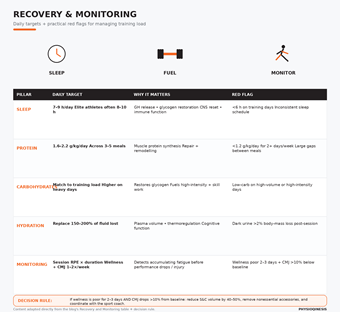
Recovery determines how much training athletes can absorb. Use the table below as a practical reference for sleep, nutrition, monitoring tools, and decision rules.
Pillar | Daily Target | Why It Matters | Red Flag |
Sleep | 7–9 hours (elite athletes often 8–10 hours) | Growth hormone release, glycogen restoration, CNS reset, immune function | <6 hours on training days; inconsistent sleep schedule |
Protein | 1.6–2.2 g/kg/day, spread across 3–5 meals | Maximizes muscle protein synthesis, supports repair and remodelling | <1.2 g/kg/day for 2+ days/week; large gaps between meals |
Carbohydrates | Match to training load (higher on heavy days) | Restores muscle glycogen, fuels high-intensity work and skill sessions | Low-carb on high-volume or high-intensity days |
Hydration | Replace 150–200% of fluid lost in training | Maintains plasma volume, thermoregulation, cognitive function | Dark urine, >2% body mass loss post-session |
Monitoring | Session RPE × duration; wellness (sleep, fatigue, soreness, mood); CMJ 1–2×/week | Detects accumulating fatigue before performance drops or injury occurs | Wellness poor 2–3 days + CMJ down >10% from baseline |
Practical decision rule: If wellness scores are poor for 2–3 consecutive days and CMJ drops >10% from baseline, reduce S&C volume by 40–50%, remove nonessential accessories, and coordinate with the sport coach. In congested weeks, preserve a small amount of intensity but cut total sets.
Common Mistakes
- “Don’t lift heavy in-season”: Appropriately Prescribed heavy work maintains strength and tendon resilience; excessive volume is the problem, not intensity.
- No real off-season: Year-round competition without a development block limits long-term progress and increases injury risk.
- Copying pro programs: Scale load to your athletes’ age, training age, and recovery resources.
- One program for all: Individualize based on position, minutes, injury history, and response to training.

Bottom Line
Off-season builds the engine; in-season protects it. Use periodization to vary stress and priorities across the year. Build broadly off-season, sharpen pre-season, and maintain intelligently in-season. That’s how you keep athletes healthier, faster, and stronger when it actually matters.