

Author :- Kimaya Kadam
Physiotherapy Perspective: Stabilize, Align, and Protect
1. Core Stability & Neuromuscular Control
Key Core Exercises (2x/week):
· Dead Bug with Resistance Band – 3 sets x 10 reps (each leg)
· Pallof Press (anti-rotation) – 3 sets x 30 seconds hold/side
· Side Plank with Leg Lift – 3 sets x 20 seconds each side
· Bird-Dog with Reach & Hold – 3 sets x 10 reps
These target deep core muscles (transversus abdominis, multifidus) that stabilize the spine and pelvis during dynamic motion.
Strength & Conditioning Perspective: Develop Power at Every Phase
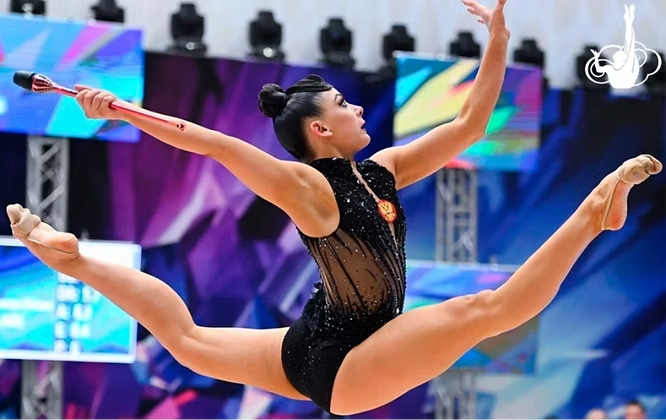
Leaps require concentric strength for push-off, reactive power in the stretch-shortening cycle, and coordination at takeoff and landing. Here’s how to build these attributes.
2. Resistance Training (Strength Base)
Resistance training helps gymnasts produce more force during take-off and improves joint control on landing.
Lower-Body Strength Exercises (2x/week):
· Goblet Squats – 3 sets x 8–10 reps (builds quad and glute strength)
· Rear-Foot Elevated Split Squats (RFESS) – 3×6/leg (targets single-leg stability and power)
· Nordic Hamstring Curls (eccentric focus) – 3×4-6 reps (hamstring resilience)
“Even light-to-moderate resistance loads (30–60% 1RM) performed explosively can enhance jump outcomes,” (Markovic & Mikulic, 2010).
3. Plyometrics & Ballistic Power Training
These improve the rapid force production needed in leap take-off.
Plyometric Drills (2–3x/week):
· Hurdle Hops (linear) – 3×6 (focus on minimizing ground contact time)
· Single-Leg Box Jumps – 3×5 each leg (control and propulsion)
· Depth Jumps from 30–40cm – 3×5 reps (advanced gymnasts only) Ballistic Exercises:
· Medicine Ball Overhead Throw to Jump – 3×6 (sequencing of upper & lower body)
· Jump to Stick Landing (with pause) – 3×5 (emphasizes landing mechanics) Mobility & Flexibility:
Smart Stretching
4. Dynamic Warm-Up, Not Static
Static stretching pre-performance has been shown to reduce muscle stiffness and impair jump performance by 5–10% (Dallas et al., 2014). Judges’ scores even declined after pre-performance static stretching.
Instead, use dynamic mobility drills like:
· Leg Swings (front/back, side/side) – 3×10 each
· Walking Lunges with Twist – 2×10 steps
· High Knees & Skips – 2x20m
· Hip Openers (toy soldier kicks, knee circles) – 2×10 each
Save static flexibility work (e.g., over splits, passive holds) for post-training or separate sessions.

Day | Focus | Content |
Mon | Plyometric & Core | Hurdle hops, med ball jumps, dead bugs |
Tue | Resistance & Flexibility | RFESS, goblet squats, oversplit training |
Wed | Skill & Dance (Technical Day) | Leap drills, technique, beam coordination |
Thu | Plyo + Ballistic Combo | Depth jumps, box jumps, side planks |
Fri | Resistance + Recovery | Nordic curls, Pallof presses, mobility |
Sat | Artistic/Choreography Work | Routine development, expression |
Sun | Rest or light active recovery | Stretching, swimming, walking |