

Neuromodulation & Brain-Based Training
Author :- Ms. Shraddha Dixit
Neuromodulation & Brain-Based Training
Acute effects: mixed, and specific
Chronic protocols look more promising with a caveat
Why the skepticism is warranted

Practical application: if you're going to pilot this, do it carefully
Any exploratory use belongs in a monitored, small-N pilot with a clear pre-registered outcome measure not
a blanket rollout, given how heterogeneous the protocols in the literature already are. Screen athletes for
contraindications (skin conditions at electrode sites, history of seizures, implanted devices) and document
informed consent, since this is a medical-adjacent intervention even at low current intensities. Expect
individual variability: response to is not uniform, and the same protocol that produces a training
augmentation effect in one athlete may do nothing in another build in a way to identify non-responders
early rather than assuming a fixed effect size across your roster. Track the regulatory picture; anti-doping
bodies have not banned outright, but rising use under the ‘neurodoping’ label is already attracting scrutiny,
and rules can move faster than the evidence base.
• Strongest current evidence: transient isometric strength gains acutely; larger strength/power/aerobic
gains when combined with a real training block over multiple sessions.
• Weakest current evidence: standalone use without concurrent training; jump power as an acute
outcome; generalization from non-athlete to elite-athlete populations.
• Unresolved: optimal montage, dose, and timing protocols in the literature are heterogeneous enough
that direct replication across labs is difficult.
Common mistakes practitioners make with this technology
The most common mistake is reading a single positive headline finding ( improves strength’) and applying it without checking whether the study population, outcome measure, and protocol have anything to do with your athletes and your goals the difference between ‘acute isometric strength in a lab task’ and ‘competition sprint performance in a trained athlete’ is enormous, and the literature does not support treating those as interchangeable claims. A second mistake is ignoring the placebo/sham-control quality of the underlying study; some early positive findings in this space came from designs with weak blinding, and the field’s more recent systematic reviews are noticeably more cautious than the popular press coverage of the same topic. A third mistake is skipping athlete-level response tracking because individual variability in response is well documented, a coach who applies one fixed protocol to an entire roster and reports an average team effect can miss the fact that half the athletes had no meaningful response at all, which matters enormously for deciding whether to continue the intervention with a given individual.
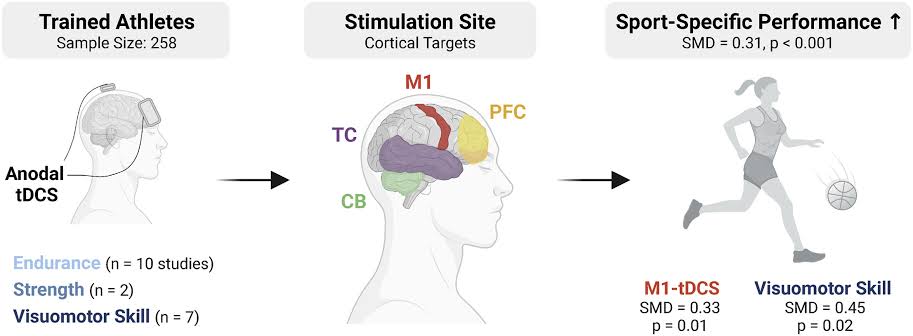
Bottom line: shows real acute effects on isometric strength and attention-based tasks, and more convincing training-augmentation effects over repeated sessions but small athlete-specific samples, non-standardized protocols, and non-linear dose-response mean this belongs in a monitored pilot or research setting for now, not a blanket rollout across your program.
References
• The effectiveness of transcranial direct current stimulation in improving performance in soccer players
A scoping review. Journal of Clinical Medicine.
• Transcranial direct current stimulation (tDCS) on soccer players: A mini review. Archives of Sports
Medicine and Physiotherapy, 9(1), 001-007.
• Does a single session of transcranial direct current stimulation enhance both physical and psychological
performance in national- or international-level athletes? A systematic review.
• Optimising transcranial direct current stimulation application for the enhancement of exercise
performance: A review.
• A single anodal transcranial direct current stimulation session to enhance sport-specific performance in
trained individuals? A systematic review and meta-analysis.
Neuromodulation & Brain-Based Training
Neuromodulation & Brain-Based Training
Acute effects: mixed, and specific
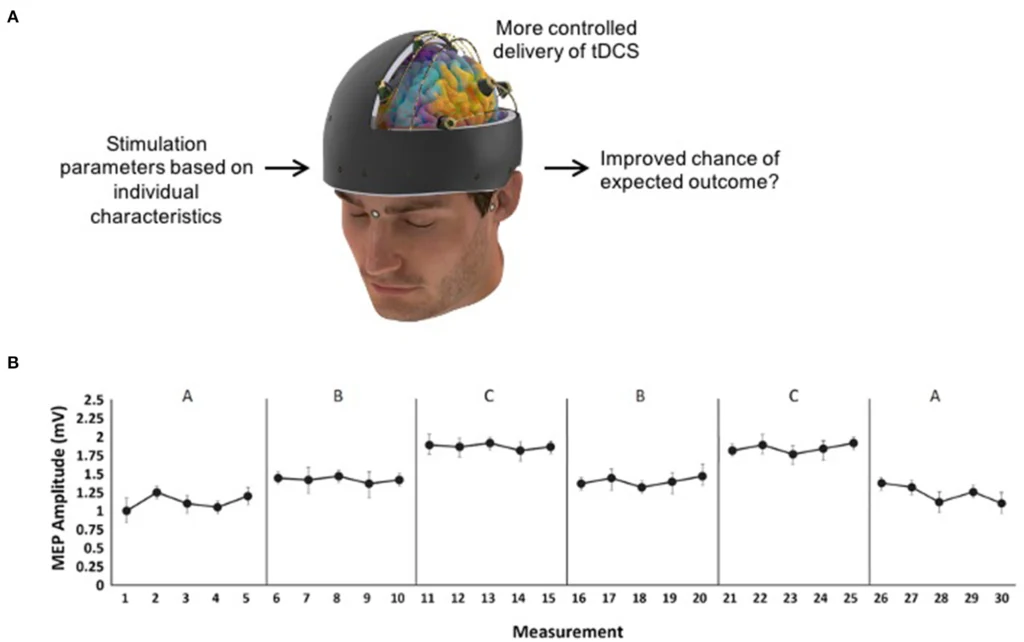
Chronic protocols look more promising with a caveat
Why the skepticism is warranted
Practical application: if you're going to pilot this, do it carefully
Any exploratory use belongs in a monitored, small-N pilot with a clear pre-registered outcome measure not
a blanket rollout, given how heterogeneous the protocols in the literature already are. Screen athletes for
contraindications (skin conditions at electrode sites, history of seizures, implanted devices) and document
informed consent, since this is a medical-adjacent intervention even at low current intensities. Expect
individual variability: response to is not uniform, and the same protocol that produces a training
augmentation effect in one athlete may do nothing in another build in a way to identify non-responders
early rather than assuming a fixed effect size across your roster. Track the regulatory picture; anti-doping
bodies have not banned outright, but rising use under the ‘neurodoping’ label is already attracting scrutiny,
and rules can move faster than the evidence base.
• Strongest current evidence: transient isometric strength gains acutely; larger strength/power/aerobic
gains when combined with a real training block over multiple sessions.
• Weakest current evidence: standalone use without concurrent training; jump power as an acute
outcome; generalization from non-athlete to elite-athlete populations.
• Unresolved: optimal montage, dose, and timing protocols in the literature are heterogeneous enough
that direct replication across labs is difficult.
Common mistakes practitioners make with this technology
The most common mistake is reading a single positive headline finding ( improves strength’) and applying it without checking whether the study population, outcome measure, and protocol have anything to do with your athletes and your goals the difference between ‘acute isometric strength in a lab task’ and ‘competition sprint performance in a trained athlete’ is enormous, and the literature does not support treating those as interchangeable claims. A second mistake is ignoring the placebo/sham-control quality of the underlying study; some early positive findings in this space came from designs with weak blinding, and the field’s more recent systematic reviews are noticeably more cautious than the popular press coverage of the same topic. A third mistake is skipping athlete-level response tracking because individual variability in response is well documented, a coach who applies one fixed protocol to an entire roster and reports an average team effect can miss the fact that half the athletes had no meaningful response at all, which matters enormously for deciding whether to continue the intervention with a given individual.
Bottom line: shows real acute effects on isometric strength and attention-based tasks, and more convincing training-augmentation effects over repeated sessions but small athlete-specific samples, non-standardized protocols, and non-linear dose-response mean this belongs in a monitored pilot or research setting for now, not a blanket rollout across your program.
References
• The effectiveness of transcranial direct current stimulation in improving performance in soccer players
A scoping review. Journal of Clinical Medicine.
• Transcranial direct current stimulation (tDCS) on soccer players: A mini review. Archives of Sports
Medicine and Physiotherapy, 9(1), 001-007.
• Does a single session of transcranial direct current stimulation enhance both physical and psychological
performance in national- or international-level athletes? A systematic review.
• Optimising transcranial direct current stimulation application for the enhancement of exercise
performance: A review.
• A single anodal transcranial direct current stimulation session to enhance sport-specific performance in
trained individuals? A systematic review and meta-analysis.
